
Why should we think about creativity beyond humans?
For my dissertation I’m expanding current research on creativity to encompass other non-human creatures. In a world that is constantly creating and re-creating itself it doesn’t make sense to think about creativity as an exclusively human endeavor. I want to understand what happens in interspecies creative encounters and how can they be facilitated through learning design? To that end, I focus on the context of biodesign where humans and other organisms generate artefacts by engaging with each other.
I frame these explorations with the open concept of interspecies creativity to describe what occurs when humans–specifically biodesign experts, novices and myself–come together with mycellium–the underground networks of fungi–to materially produce something through their relationships with one another. Through this process, I look for design principles to construct learning experiences, materials, and tools for creative emergence and critical reflection about the relationships between learners and other organisms.
The blossoming field of bio-design integrates biology and design to imagine how to build at the edge of the natural and the artificial. Biodesign, and specifically biofabrication, refers to the integration of living organisms or ecosystems as essential components of design processes or products (Myers, 2019) for functional, aesthetic, political, or explorative purposes. In biofabrication, designers together with living organisms do not strictly build but grow things such as leather from bacterial cellulose, bricks from fungal mycelium, or fabric threaded by silkworms or grass roots (see the work of Lee, 2005; Klarenbeek, 2021; Oxman, 2020; Scherer, 2021). By blurring the boundaries between the practices of making and growing, biodesign makes the entangled relationships between culture and nature, humans and non-humans, life and non-life explicit and open to interrogation (Radomska, 2017). An engagement with biology that is both critical and creative may unravel nuanced reflection on the ontology of life as creators learn to work with or against the agency, intelligence, and creativity inherent in non-human agents and entities. Yet, no form of design is neutral and biodesign practices can either reinforce narratives of domination and subjugation of nature or challenge them by exploring alternative forms of relations and their ethical and political implications.
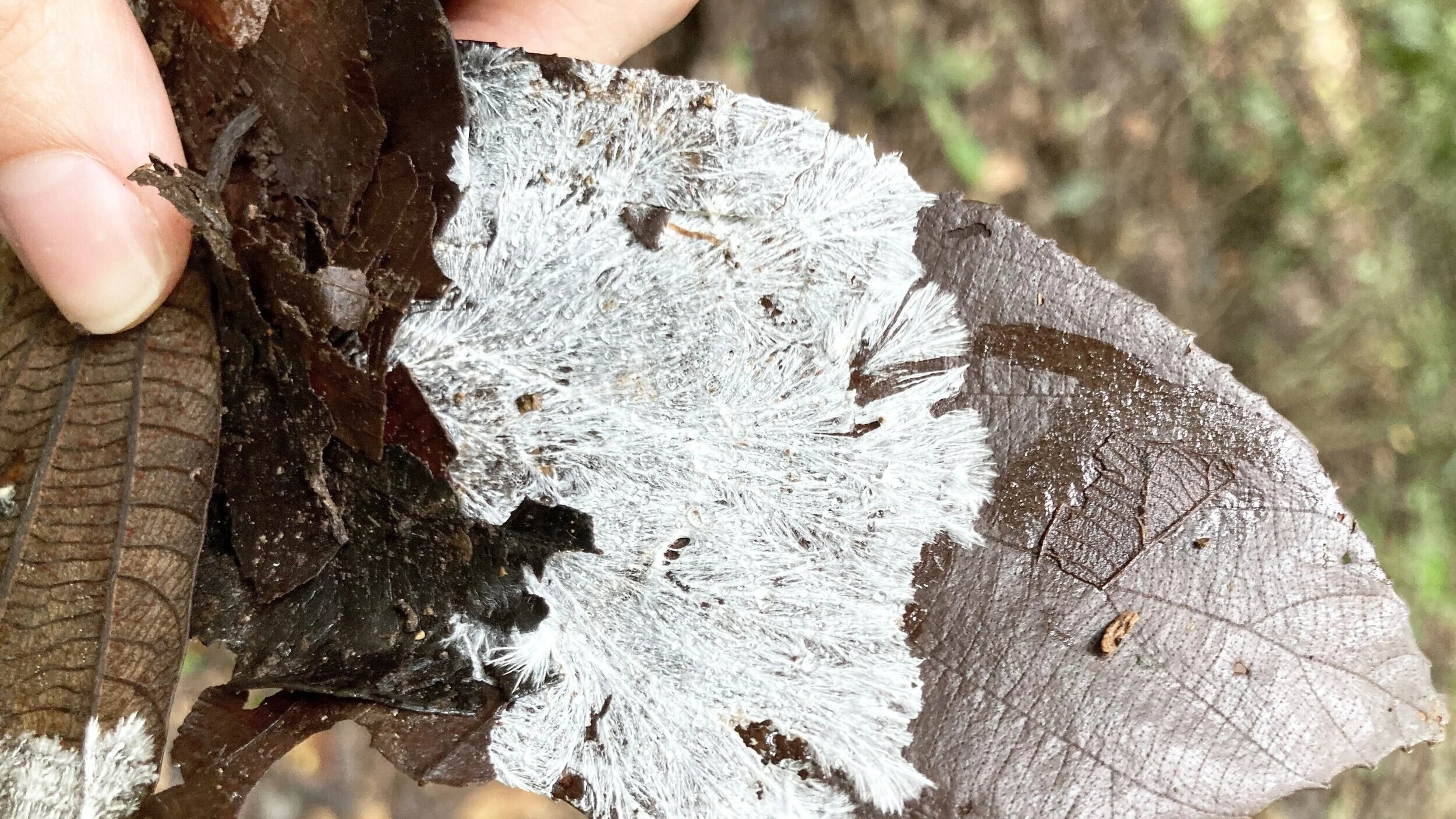
Finding mycelium under decaying leaves after a rainy day
Growing in the tensions between fields, biodesign is inherently transdisciplinary. That means it can be stretched in different directions allowing for multiple ontological and epistemological dispositions: It can be cold and clean as rationalistic science, controlling as systematic as engineering and manufacturing, but also irreverent as art or messy as cooking. Research on interdisciplinary learning shows how knowledge and creativity flourish across different epistemologies (Gardiner, 2020). Therefore, it is critical that, as biodesign enters into education, multiple ways of knowing are allowed. Biodesign can become what anthropologist Escobar (2018) eloquently calls a Pluriverse, a “world where many worlds fit” (p. xvi), a place where multiple ways of being in the world – including all sorts of humans but also non-human creatures – can collectively find ways of becoming-with each other in the world.
As we enter what has been labeled the biological age (Oxman; 2020), expanding our understanding of creativity beyond the human realm and in relation to other life forms might be critical to support learning in biodesign practices. Biodesign is an emergent but fast-growing discipline and, while development happens mostly in secluded laboratories in industry and academia, the growing biomaking, biohacking, and bio-DIY movements are set to democratize access to its means and knowledge (Kafai et al., 2020). Additionally, biodesign is increasingly entering learning contexts spreading the boundaries and creative possibilities of maker and STEM education (science, technology, engineering, and mathematics) (Kafai & Walker, 2020). Studying and designing learning activities, tools, and technologies to support biodesign becomes critical in the movement toward democratization and diversification of its practices.
Yet, making with living organisms is radically different from building with physical, computational or electronic building blocks (Telham & Kafai, 2020; Lui et al., 2020). First, it requires painstaking sanitation protocols and interaction with instruments and materials optimized for scientific rather than creative and learning purposes. Biomaking at home and even at community laboratories is often fulfilled by adapting and hacking cooking and crafting instruments and technologies which emphasizes the need of safe and accessible learning supports. Second, assumed effective learning practices in maker education, such as tinkering and getting immediate feedback, look very different in biodesign because it implies working with wet procedures that cannot be undone and where changes occur over different scales of time and space which highlight the need of studying what are best learning and teaching practices in this new context (Telham & Kafai, 2020). And third and most importantly, in biodesign learners are not the only agents at play (Telham & Kafai, 2020); Materials in biodesign, the “objects-to-think-with” (Ackerman, 2020), are also alive enacting their own agency and creative ways of making sense of the world, demanding recognition by bringing about the unexpected and shifting the course of design according to their own needs. For this reason, I argue that biodesign pedagogies must be informed by a broader understanding of creativity that encompasses humans and other creatures through their own ways of bringing the world about. This means taking seriously the possibility of creatively becoming-with other non-human others to see what might be possible.
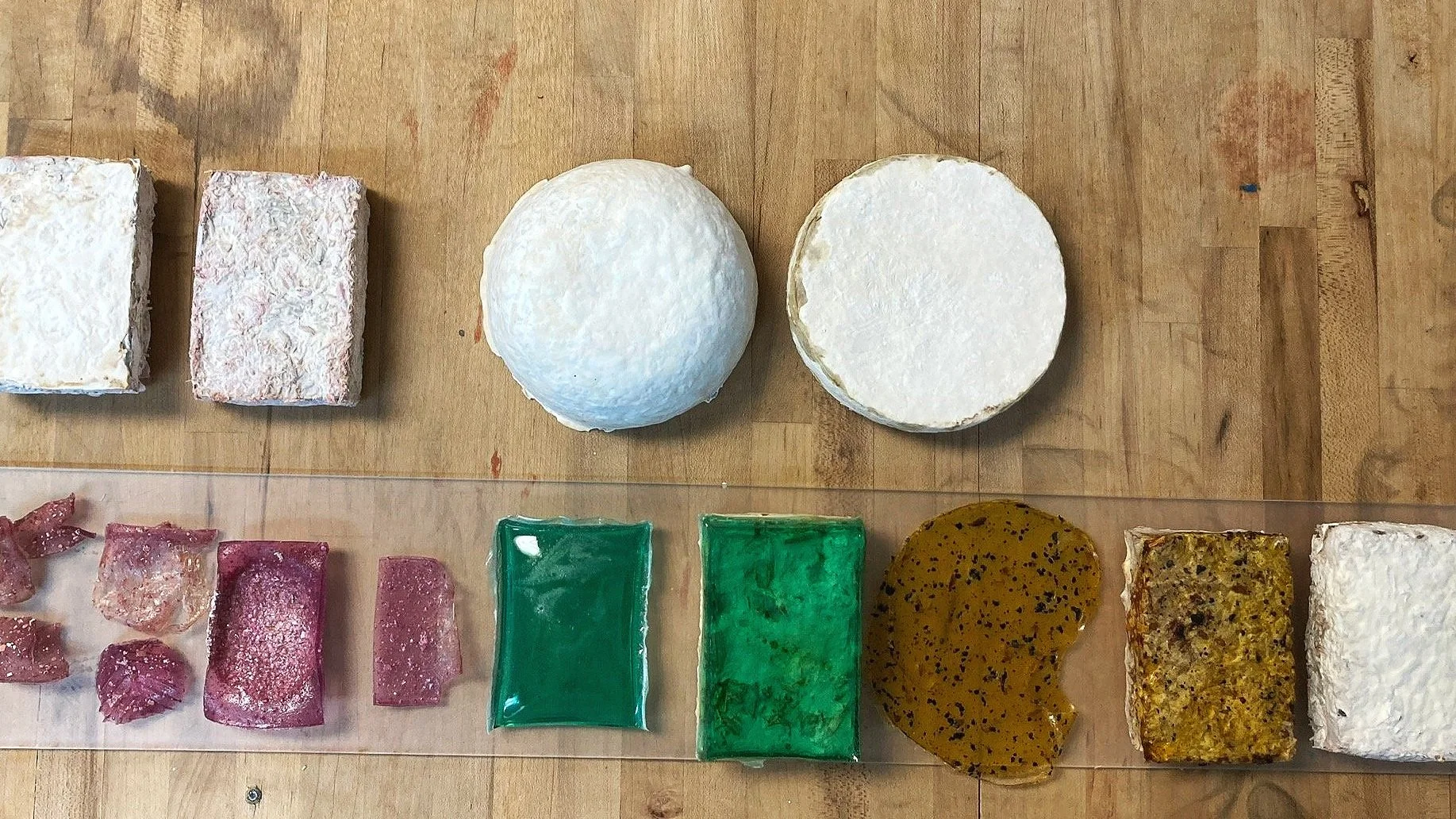
Interactions between mycelium and bioplastics
As we enter what has been labeled the biological age (Oxman; 2020), expanding our understanding of creativity beyond the human realm and in relation to other life forms might be critical to support learning in biodesign practices. Biodesign is an emergent but fast-growing discipline and, while development happens mostly in secluded laboratories in industry and academia, the growing biomaking, biohacking, and bio-DIY movements are set to democratize access to its means and knowledge (Kafai et al., 2020). Additionally, biodesign is increasingly entering learning contexts spreading the boundaries and creative possibilities of maker and STEM education (science, technology, engineering, and mathematics) (Kafai & Walker, 2020). Studying and designing learning activities, tools, and technologies to support biodesign becomes critical in the movement toward democratization and diversification of its practices.
Yet, making with living organisms is radically different from building with physical, computational or electronic building blocks (Telham & Kafai, 2020; Lui et al., 2020). First, it requires painstaking sanitation protocols and interaction with instruments and materials optimized for scientific rather than creative and learning purposes. Biomaking at home and even at community laboratories is often fulfilled by adapting and hacking cooking and crafting instruments and technologies which emphasizes the need of safe and accessible learning supports. Second, assumed effective learning practices in maker education, such as tinkering and getting immediate feedback, look very different in biodesign because it implies working with wet procedures that cannot be undone and where changes occur over different scales of time and space which highlight the need of studying what are best learning and teaching practices in this new context (Telham & Kafai, 2020). And third and most importantly, in biodesign learners are not the only agents at play (Telham & Kafai, 2020); Materials in biodesign, the “objects-to-think-with” (Ackerman, 2020), are also alive enacting their own agency and creative ways of making sense of the world, demanding recognition by bringing about the unexpected and shifting the course of design according to their own needs. For this reason, I argue that biodesign pedagogies must be informed by a broader understanding of creativity that encompasses humans and other creatures through their own ways of bringing the world about. This means taking seriously the possibility of creatively becoming-with other non-human others to see what might be possible.
I am now in the process of designing tools and pedagogies to support interspecies creativity with fungi. I will be publishing regularly about the possibilities and challenges I encounter. Soon after, I will share these practices with young kids in our local Public Schools in Harlem, NY, and hopefully in other places too! Let me know if you are interested in bringing Bioart with fungi to your community.
Suggested citation (APA):
Correa, I. (2021). Why should we think about creativity beyond humans? MariaIsabelCorrea (Blog). https://www.mariaisabelcorrea.com/blog-1/2021/9/22/6u1qtsus39drm68cph5rlp5yyk155r